
Sangar Hassan Najim
Introduction
The CDA of the representation of refugees and immigrants in media is an interesting and one of the most updated topics. The media plays an important role in shaping public perceptions. Besides, CDA offers a valuable framework for examining how media discourses contribute to the representation of refugees/immigrants. it is the power of Media discourse that shapes public opinion, influences policy decisions, and constructs social realities. That’s mainly because the CDA examines the language, ideologies, and power dynamics within media texts to reveal the motivations that shape the representation of refugees/immigrants.
This review essay covers the Critical Discourse Analysis (henceforth CDS) of the representation of refugees/immigrants in Media. In this review, three studies have been taken a PhD dissertation, an MA thesis, and a research article. All the studies are about the representation of refugees/immigrants in Media according to the CDA analysis but within different methods or approach frameworks such as Fairclough and discourse historical approach. The studies took different data and used distinct methods to analyze it. This review essay used a qualitative method in reviewing the three studies.
Studies
“Representation of Immigrants in New Zealand Print Media: A Critical Discourse Analysis” is a PhD dissertation done by Salahshour in 2017 and published by Victoria University of Wellington. The aim of the study is to improve our comprehension of the discursive construction of immigrants. Another purpose of the study is to go into expected differences in how immigrants are portrayed in hard times economically, especially in the era of the Global Financial Crisis. The study used a methodical triangulation approach, with the Discourse-Historical Approach by Wodak to comprehend how social and historical settings are reflected in and shaped by language and corpus-assisted discourse analysis as two analytical frameworks for analyzing the data. Utilizing statistical data, the researchers were able to pinpoint significant word combinations that influence how immigrants are portrayed in the media. The methodical triangulation approach in this study was used to counter the drawbacks of both CDA and critical linguistics. The material is entered using statistical information, and important collocations that support the creation of dominant representations are investigated. A thorough examination of news stories that were sampled systematically is also included in the study. The data is drawn from the New Zealand Herald newspaper between the years 2007 and 2008.
The researcher discovered that different people were portraying immigrants. Immigrants were seen as valuable workers who helped New Zealand fill employment openings on the one hand. They were regarded as a valuable financial asset. On the other side, immigrants were portrayed as problematic since they were either portrayed as dangerous or as helpless victims. Even some of the examples provided that it is only about the time that one day we see immigrants doing crime. The study’s overall findings emphasized the nuanced and occasionally contradictory representations of immigrants in the New Zealand Herald. The results shed light on how public attitudes of immigrants might be shaped by media discourse and offer new perspectives on language study.
An MA thesis was conducted by Marroquin (2022) entitled: Critical Discourse Analysis of news media representations of People from refugee backgrounds participating in Music in Australia. The thesis is published by the Queensland University of Technology. The aim of this research is to investigate how Australian news media portrays the involvement of individuals with refugee histories in the music industry. The study is also examining how race and power are discussed in the media. Therefore, basically, the author aims to comprehend the significance of music in the lives of refugees. The study used Fairclough’s three-dimensional framework (i.e., text, discursive, and social practices). Both interpretivist epistemology and critical racial theory inform it. The data of the study was drawn from fifteen media items, seven of which are online video news and eight of which are online textual news, with an emphasis on how individuals with refugee histories are portrayed in music. The researcher tried to better understand how the media supports, ignores or challenges popular narratives and preconceptions regarding refugees, Fairclough’s framework is employed. The study looks at how othering stereotypes about immigrants and music-related social norms interact. By using the concepts of critical discourse analysis to examine how individuals from refugee backgrounds are portrayed in the news media when they perform music, this study advances the discipline of critical discourse analysis. It broadens our comprehension of how racialized discourses and power relations function within media narratives. The study offers a thorough examination of the language, social practices, and sociocultural contexts that influence how refugees are portrayed in the media by utilizing Fairclough’s three-dimensional framework. Moreover, the research integrates interpretivist epistemology, critical race theory, and critical discourse analysis. By taking into account the intersectional dynamics of racism, power, and language in media discourse, this multidisciplinary approach enhances the study. Some of the examples that illustrate how music can challenge dominant narratives are Trauma as dominant discourse, personal growth, music and gratefulness, music as a vessel for stereotypes, and music activism.
The most important findings of this study are although the media tells reports of happiness and optimism brought about by music, it also upholds racialized power relations. Australians are frequently regarded as saviors, whereas refugees are frequently framed as victims or traumatized. The study highlights the necessity of elevating the voices of migrants and acknowledging the activist function of music in their existence. It emphasizes how crucial critically reflective social work practice is to subvert prevailing narratives that marginalize and “other” refugees.
Munandar and Akmal (2023) conducted a study entitled: A Critical Discourse Analysis of the Representation of Ukrainian Refugees Across the British Mainstream News Media. This study is published in the Journal of Studies in English Language and Education. The purpose of the study is to look into the major discursive and rhetorical techniques used by British mainstream news outlets while covering Ukrainian migrants. The researchers used both the discourse-historical approach (DHA) to understand how historical events, ideologies, and power dynamics are reflected and reproduced in speech and the CDA approach to analyze how Ukrainian migrants are portrayed in the mainstream news media in Britain. The data are drawn from British newspapers mainly (The Daily Mail, The Daily Mirror, The Telegraph, and The Guardian) in which Purposively selected news is extracted. Between March and July 2022, 40 news stories from four UK mainstream news sources were examined.
The researchers showed that themes and rhetorical devices were found in the news clips by applying qualitative analysis approaches. The most significant findings showed a contrast to other studies that revealed negative images of migrants, the study discovered that Ukrainian refugees were positively portrayed in British mainstream news media. The results suggest that the way Ukrainian migrants are portrayed in the media may be biased and framed.
Review
The first study: Representation of Immigrants in New Zealand Print Media: A Critical Discourse Analysis, focuses on the representation of immigrants in New Zealand media by applying a CDA approach. Some positive points of this study can be summarized as:
1- It addresses an important and the most updated topic of immigrant representation in print media.
2- Applying the CDA approach make a deep examination of the language that is used to construct immigrant identities in the newspaper.
3- The study’s analysis includes statistical information to uncover dominant representations of immigrants.
4- The method used (triangulation) within the Discourse-Historical Approach by Wodak, enhances the reliability and validity of the findings.
5- Both positive and negative aspects of immigrants are represented.
6- The study is important as it recognizes the socio-political and geographical context of New Zealand.
7- the chapters of the study are well organized and the inclusion of a comprehensive literature review on CDA, immigration policies, and media ownership makes the background of the study unique.
8- The study provided suggestions for further studies with a larger corpus.
While the study has these positive points, also some critics can regard them as negative points:
1- The data of the study focus on a specific newspaper (New Zealand Herald), although the specificity is good, but mostly restricts the generalizability of the findings.
2- The study was done in 2017, and the researcher chose the data from a time frame (2007-2008), and that may not capture contemporary changes.
3- relying solely on the analysis of media texts and not explicitly addressing the perspectives of immigrants themselves, may not be good. Therefore, a comparative study is important in such subjects.
4- Examining only one kind of media (i.e., print), and neglecting the online and social platforms.
5- The study does not explicitly provide the role of journalists in shaping immigrant representation.
The second study: Critical Discourse Analysis of news media representations of People from refugee backgrounds participating in Music in Australia, focuses on analyzing how news media in Australia portrays people from refugee backgrounds participating in music. This study is an MA thesis submitted in fulfillment of the requirements for the degree of Master’s degree (Social Work) at Queensland University of Technology 2022. Some positive points that can be extracted from this study are, that the study tackled an important point which is examining the representation of refugees in the media within contributes to comprehending the role of music in the lives of refugees. The study by using CDA provided a systematic approach to analyzing media narratives. Besides, incorporates interpretivist epistemology and critical race theory, enhancing the analysis of power and social constructions. Additionally, the research design and methodology are well organized and defined, including the theoretical framework. The analysis of the study showed the intersection of music-related tropes surrounding refugees and highlights how media usually frames refugees as victims and Australians as saviors.
While the study has these positive points, also some critics can regard them as negative points, such as: Focusing on the Australian news media only, may restrict the generalizability of the findings. Besides, the sample size of 15 media reports may not capture the complexity of representations of refugees in the media relying solely on media analysis and does not explore the perspectives and experiences of refugees themselves. The researcher has not specified the timeframe of the study, and this makes it difficult to assess the relevance of the media reports analyzed. The study does not clearly discuss the motivations of media organizations in shaping these reports and stories.
This third study titled “A Critical Discourse Analysis of the Representation of Ukrainian Refugees Across the British Mainstream News Media” investigates how Ukrainian refugees are portrayed in the UK news media. The method used in the study is the Discourse-Historical Approach to analyze 40 news reports and identify six analytical categories: Referential, Predication, Argumentation, Perspectivization, Mitigation, and Intensification. Some positive points of this study can be: filling a gap by examining the portrayal of Ukrainian refugees, which has been lacking in earlier research. focusing on Ukrainian refugees, make the study to be unique with its use of a comprehensive analytical framework. The study challenges previous studies’ findings by providing evidence of the news media’s consistent use of positive discursive strategies in depicting Ukrainian refugees.
However, there are some restrictions to consider. The study only analyzes 40 news reports from four mainstream news outlets in the UK namely (The Daily Mail, The Daily Mirror, The Telegraph, and The Guardian), which may not represent the entire media landscape. Additionally, the study does not explore the impact of these discursive strategies on public perception.
Finally, the next table illustrates the accurate similarities and differences between the selected Studies.
Table 1 illustrates the accurate similarities and differences between the selected Studies.
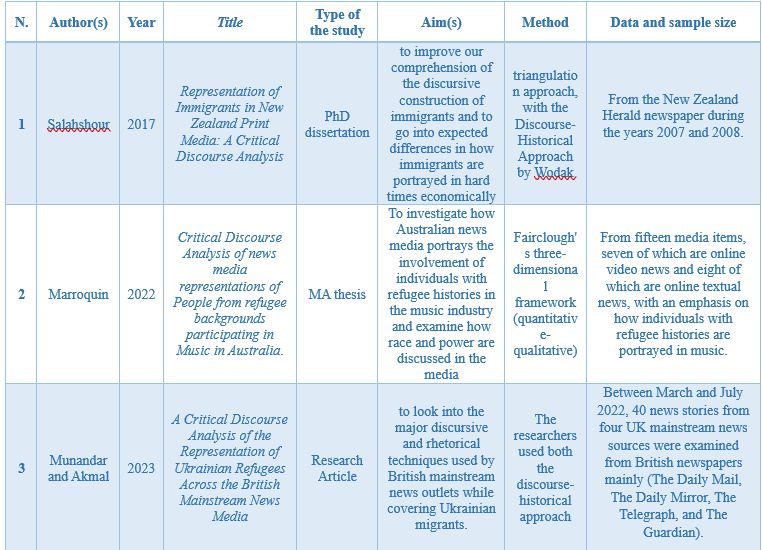
This review essay is important as the representation of refugees/immigrants is one of the most updated topics nowadays, the CDA approach applied to these studies is crucial because it examines how media discourses contribute to the representation of refugees/immigrants. Media has its power in shaping public opinions and it has its impact on decisions. This review essay covered three studies, a PhD dissertation, An MA thesis, and a research article. The studies are good, as they used different methods within distinct approaches, but still, they need large corpora and it is believed that the print media is not enough there should be also social media to deal with it as data.
References (Works Reviewed)
Marroquin, CH. Janneth, a.. “Critical Discourse Analysis of News Media Representations of People from Refugee Backgrounds Participating in Music in Australia.” An MA Thesis. [Online] Available at: https://web.archive.org/web/20220508001609id_/https://eprints.qut.edu.au/230264/1/Angela%20Janneth_Charry%20Marroquin_Thesis.pdf [Accessed 27 Dec. 2023].
Munandar, I., Akmal, S., “A Critical Discourse Analysis of the Representation of Ukrainian Refugees across the British Mainstream News Media.” Studies in English Language and Education, vol. 10, no. 3, 16 Sept. 2023, pp. 1569–1584, Doi: https://doi.org/10.24815/siele.v10i3.28014 [Accessed 24 Dec. 2023].
Salahshour, N. (2017). Representation of immigrants in New Zealand print media: A critical discourse analysis. A PhD Dissertation. researcharchive.vuw.ac.nz. [online] Available at: https://researcharchive.vuw.ac.nz/xmlui/handle/10063/6226 [Accessed 25 Dec. 2023].